

Historic Landmarks & Museums
In a county that dates back more than two centuries, the stories are filled with fascinating facts and historic figures, while the architecture is rich in character. The county’s history of sacrifice runs deep here; the earliest veterans in Daviess County were former soldiers of the Revolutionary War. Today, four beautifully designed war memorials are popular spots for reflection.

DAVIESS COUNTY MUSEUM
The Daviess County Historical Society is dedicated to the collection, preservation, research, organization, exhibition, and/or acquisition of artifacts, documents, sites, and other historical relics, regardless of medium, which are significant to the history of Daviess County, and thereby educate by promoting the historical study of said county, and strive to describe, or illustrate, the social, political, industrial, and educational progress of Daviess County Indiana.

Historic
Districts

Experience downtown Washington in a whole new way with our interactive historic walking tour. Follow the trail through downtown and stop at featured landmarks along the way. At each location, scan the QR code to access unique stories, photos, and history—available only to those exploring in person.
.png)
Historic
Landmarks
Whether you're a history enthusiast, an architecture lover, or simply seeking a glimpse into the lives of those who came before us, our carefully curated selection of historic sites promises to inspire and educate.

State & National Registry
Magnus J. Carnahan House
511 E. Main St.
Washington, IN
In addition to being significant for its architecture, the house is significant as the only known extant structure associated with Carnahan, a prominent local businessman. The house reflects the prosperity of Washington during the late 19th and early 20th century. Washington was first settled about 1812. The house was listed on the State & National Register in 1991.

State & National Registry
Thomas Faith House
1208 Bedford Rd.
Washington, IN
The Thomas Faith House is one of a small number of extant structures associated with the settlement period in Daviess County, which extended from about 1800 to 1850. Thomas Faith was a farmer and cabinetmaker, who came to Daviess County from Pennsylvania in 1817. The house was added to the State and National Register in 1994.

State & National Registry
Jefferson Elementary School
Donaldson Rd.,
.25 mi. E of IN 57
Washington, IN
Jefferson School is a locally significant example of the way Hoosiers met the changing demands on public education in the early 1900s. Built in 1922, the Jefferson School represents the ideal rural consolidated school building of the period. The school was added to the State & National Registery in 1997.

State & National Registery
Dr. John A. Scudder House
612 E. Main St.
Washington, IN
The Dr. John A. Scudder House is significant in the area of architecture as the earliest Second Empire house in Daviess County. It is one of the few existing residential buildings in this style. Of the only 3 Second Empire buildings listed in the County Interim report, The Scudder house pre-dates the others by nearly 20 years. Built in 1861 and listed on the State & National Register in 1995.
.jpg)
State & National Registery
Washington Commercial Historic District
Roughly bounded by Fourth, Hefron and Meridian Sts. and the Chessie System RR
Washington ,IN
The Washington Commercial Historic District is significant as the market place of the most important settlement in Daviess County. Washington, platted in 1817, achieved prosperity because of its designation as the county seat, through agriculture and coal mining, and for its position on important transportation routes. Listed on the State & National Register in 1990.
.jpg)
State & National Registery
Knox County Bridge #45
Carries Knox County Road 229 over the White River
Knox County Bridge #45 is the single remaining three-span Pratt through truss bridge in either Knox or Daviess Counties and has made a significant contribution to broad patterns of history, specifically the development of transportation infrastructure between the two counties, boosting economic growth. Listed on the State & National Register in 2006.

State & National Registry
Daviess County Courthouse
200 E. Walnut St.
Washington, IN
The Daviess County Courthouse is one of four outstanding public examples of Neo-Classical Revival-inspired architecture in the City of Washington. It is also a landmark in historic downtown Washington, sharing a long and rich history in commerce, industry, and transportation.

State & National Registry
Robert C. Graham House
101 W. Maple St.
Washington, IN
Residence of Robert C. Graham (1885-1967), pioneer glass, truck and auto manufacturer. Placed on the National Register of Historic Places in 1983 by the U.S. Department of the Interior because of its history and Prairie Style architecture.

State & National Registry
McCall Family Farmstead
4914 E. 800 N.
Plainville, IN
The McCall Family Farmstead is significant in the history of agriculture in Bogard Township and for its embodiment of the characteristics of an affluent farmstead. Built in 1883 (house) and listed on the State & National Register in 2013.

State & National Registery
Old Union Church and Cemetery
1125 E
Approx 3/8 mi. S of jct. with 700 S
Alfordsville, IN
The Old Union Church and Cemetary is representative of the once prevalent rural church which served both the spiritual and social needs of agricultural communities throughout Indiana. Located in Reeve Township, this primarily agricultural area was one of the first townships formed by the commissioners in 1817. Listed on the State & National Register in 2005.

State & National Registery
Dr Nelson Wilson House
103 E National Highway
Washington, IN
The Dr. Nelson H. Wilson House is an elaborate and wee-preserved example of late 19th century Queen Anne architecture. Built in 1893, the Wilson House illustrates the rise of Washington as a regional rail and commerce center at the turn of the century. Listed on the State & National Register in 2008.
.png)
Hidden
Gems
 Hatchet HouseThe Hatchet House in Washington, Indiana, is a historic basketball arena known for its arched roof, wooden bleachers, and championship banners. Since 1966, it’s hosted countless high school tournaments and produced stars like the Zeller brothers, standing as a proud symbol of the community’s basketball legacy. |  Abraham Lincoln StatueIn Odon Park, a statue of Abraham Lincoln, carved by local artist Ira Correll and dedicated in 1922, honors the nation’s 16th president. Located in the Old Settlers section, it is one of Correll’s many regional carvings, including pieces in the local cemetery. | 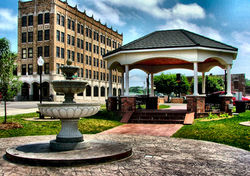 Merrideth Park PlazaMeredith Park Plaza is a downtown park in Washington that honors the former Meredith Hotel, a cornerstone of Washington since 1880 and home to Civil War veteran and businessman William R. “Billy” Meredith. Lost to fire in 2007, the site now serves the community with a gazebo, fountain, picnic tables, benches, and preserved historic elements. The plaza is a gathering place for events, celebrations, and everyday enjoyment—linking downtown Washington's past to its future. |  Carnegie Public LibraryWashington Carnegie Public Library is a historic and educational landmark in downtown Washington. Opened in 1902 as Indiana’s first Carnegie library, it reflects Andrew Carnegie’s vision of free public libraries as centers of learning and civic life. Today, the library is especially known for its genealogy and local history resources, continuing to serve the community as a vital cultural hub. |
|---|---|---|---|
 Singleton Round barnThe Thomas Singleton Round Barn, built in 1908, is one of only a handful of such rare barns still standing in Indiana. Its architectural design once symbolized innovation in farming practices and remains an eye-catching landmark today. Another site rich in heritage is the Corning Irish Heritage Center. Once home to St. Patrick’s Catholic Church and its rectory, it now preserves the culture and legacy of 19th-century Irish immigrants. |  Washington Catholic Bird CageThe Bird Cage at Washington Catholic High School, is a beloved, historic basketball gym known for its intimate, old‑school charm and passionate game‑day atmosphere. Built in the 1920s and nicknamed “The Bird Cage,” the gym has long been a backdrop for spirited high school basketball, where fans feel close to the action and memories pile up over generations of Cardinals hoops. Its classic design and community tradition make it a cherished part of Indiana’s rich basketball heritage. |